⚖️ Ecommerce Operating Model

Agency, In-House,
or Hybrid?

Choose the ecommerce growth model that gives you the right capabilities, at the right speed, with a clear path to profitable scale—not simply the lowest visible line item.

By Mitch · Updated July 17, 2026 · 10 min read
Book a Growth Audit
First Spark Digital comparison of ecommerce agency, in-house, and hybrid marketing models

The Short Answer

Choose the Model That Solves the Bottleneck

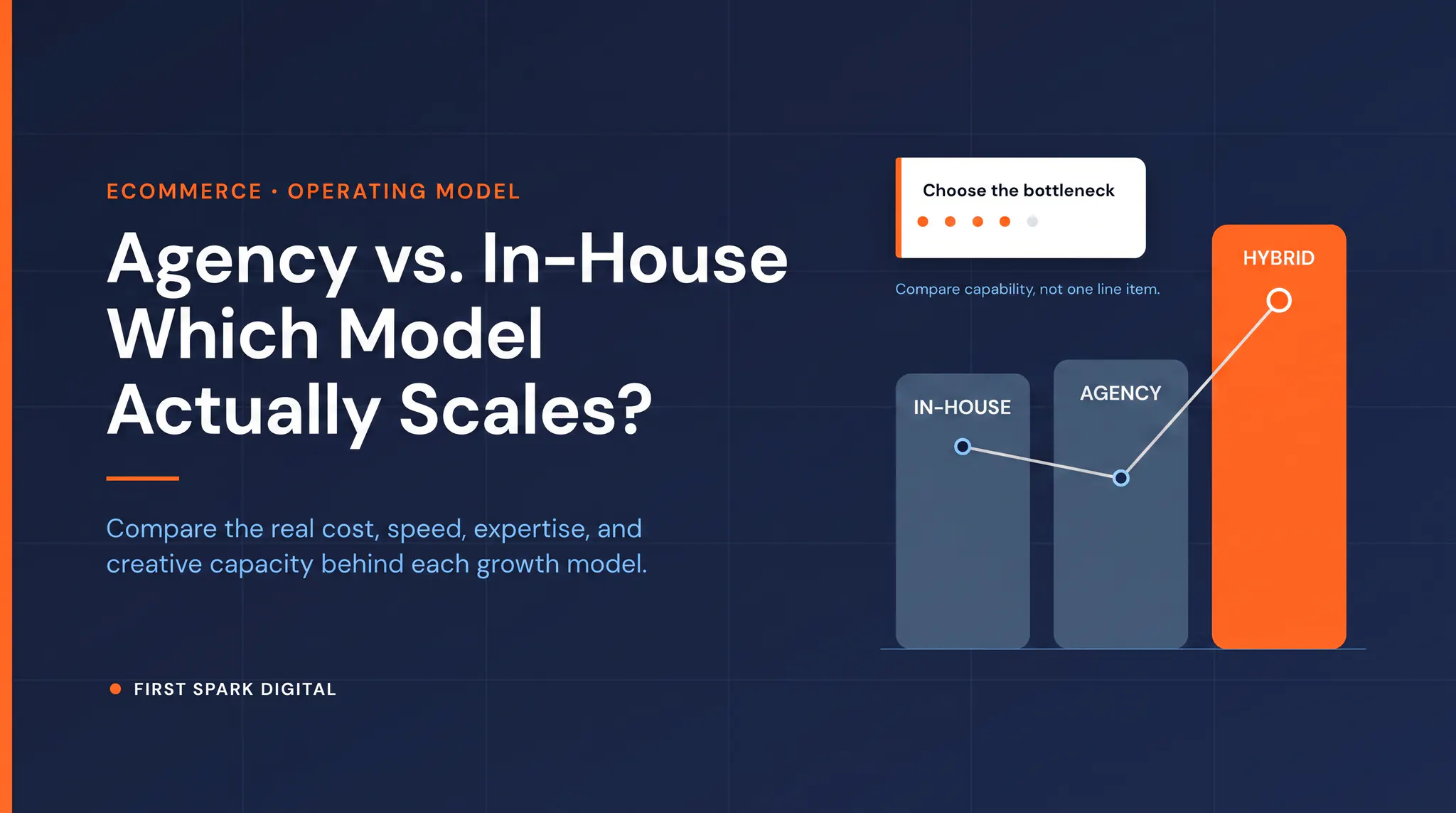
In-house wins on embedded context. Agencies win on immediate specialist capacity. Hybrid often wins when a strong internal owner needs external depth and creative velocity.

ModelBest whenMain advantageMain risk
In-houseBrands with enough scale to keep specialists fully utilizedEmbedded brand and customer knowledgeSlow hiring, narrow bench, and management overhead
AgencyBrands that need specialist depth and execution capacity quicklyImmediate access to a broader capability stackWeak partners create distance, opacity, or junior-team handoffs
HybridBrands with a strong internal growth owner who needs more depthBrand context inside; specialist capacity outsideUnclear ownership can create duplicated work

Real Economics

The Cost Comparison Most Brands Get Wrong

The wrong comparison is one agency retainer versus one employee salary. A functioning ecommerce growth operation may require strategy, paid-media buying, creative strategy, design and editing, analytics, lifecycle marketing, landing-page optimization, and project management. One strong hire rarely covers the entire stack at the level required to scale.

$161,030

US median annual wage for marketing managers in May 2024—a broad national benchmark, not an ecommerce-specific quote. BLS

$5K–$50K

Monthly digital-marketing agency range reported by Clutch. Scope, experience, location, and services materially change the fee; media spend is separate. Clutch

Salary is not the full employer cost. Benefits represented 29.9% of private-industry employer compensation in December 2025, before recruiting, software, contractors, or executive management time. BLS compensation data

Compare the complete capability stack over 12 months—not the two easiest numbers to place in a spreadsheet.

For a deeper breakdown of retainers and fee structures, read our ecommerce marketing agency pricing guide.

Seven Operating Factors

Agency vs. In-House, Beyond the Org Chart

The right model depends on how each option changes the speed, quality, and economics of the work—not where the people sit.

01

Fully loaded cost

In-house

Include salary, benefits, recruiting, software, contractors, and management time. Add the external support one hire still needs.

Agency

Include the retainer, production fees, scope changes, and exclusions. Keep media spend separate—it exists in either model.

Decision rule: Compare equivalent capabilities over 12 months, not one salary against one retainer.

02

Speed to capability

In-house

Recruiting and onboarding take time. A strong hire still needs context, systems, and internal support before performing at full speed.

Agency

A mature team arrives with workflows, channel specialists, and production resources. That advantage disappears if the partner needs heavy supervision.

Decision rule: If the cost of waiting is high, value time-to-capability explicitly.

03

Specialist depth

In-house

Internal teams build deep company knowledge, but a small group can become dependent on one person's channel experience.

Agency

A strong specialist partner sees more campaigns, creative tests, and account patterns. Verify that experienced operators will work on the business.

Decision rule: Choose the model that gives the actual operators enough depth for the problem.

04

Creative production capacity

In-house

Internal teams can build a distinctive voice, but sustained concepting, scripting, design, editing, iteration, and analysis require more than one creative hire.

Agency

An agency can add a repeatable production system and a wider bench—if the work is tied to hypotheses and contribution margin, not an asset quota.

Decision rule: Measure useful learning cycles, not the number of files delivered.

05

Brand and customer context

In-house

An embedded team naturally absorbs customer conversations, product constraints, inventory realities, and internal priorities.

Agency

External teams start with less context and must earn it through disciplined intake, access, and feedback loops.

Decision rule: Keep customer truth and final business accountability inside the company.

06

Accountability and incentives

In-house

Employees are close to the business, but proximity does not prevent teams from optimizing channel metrics that fail to improve margin or cash flow.

Agency

Contracts create explicit deliverables, but they can reward activity over outcomes when scope centers on reports, asset counts, or spend management.

Decision rule: Define success using business economics—not only ROAS, clicks, or attributed revenue.

07

Management and tooling overhead

In-house

You own hiring, coaching, career development, software, process design, and coverage when someone leaves.

Agency

The partner owns its team and operating system, but your company still needs a decisive internal owner. Execution can be outsourced; leadership cannot.

Decision rule: Name who manages priorities, inputs, approvals, and tradeoffs every week.

Fit by Stage

When Each Model Wins

In-house is not automatically more strategic, and an agency is not automatically more efficient. The operating conditions determine the result.

Build in-house when

  • Marketing is a durable core competency you can fund long term
  • You have enough work to keep multiple specialists productive
  • Constant product, merchandising, finance, and operations collaboration is essential
  • A strong marketing leader can recruit, coach, and evaluate the team
  • Your category requires unusually deep product and customer knowledge

Use an agency when

  • You need media, creative, CRO, or lifecycle depth faster than you can hire
  • Your team understands the business but lacks specialist execution capacity
  • Creative throughput is limiting growth
  • You need an outside operating system and more testing pattern recognition
  • You want flexibility before committing to a larger permanent team

Use a hybrid model when

  • An internal leader can own the P&L, priorities, and customer context
  • External specialists can add performance creative, media, CRO, and lifecycle depth
  • The business is not ready to keep every required specialist fully utilized
  • A shared scorecard can connect channel work to contribution margin and payback
  • Both sides can work from one decision cadence and one commercial target

EcommerceFuel's synthesis of operator experiences captures both sides: agencies can fill knowledge gaps quickly and reduce internal workload, while weak partners may overstate capability, create hidden costs, or reduce transparency. These are operator experiences, not universal outcomes. EcommerceFuel

The Growth-Stage Default

Why Hybrid Often Fits DTC Brands Best

Hybrid works when ownership stays internal and specialist capacity stays flexible. An internal growth owner keeps the P&L, priorities, customer context, approvals, and cross-functional decisions. The agency supplies performance creative, paid-media depth, testing systems, CRO support, and lifecycle expertise.

Internal owner

Owns the economics, priorities, customer truth, and decisions

Agency partner

Adds specialist depth, creative velocity, and operating systems

Shared scorecard

Connects channel work to margin, payback, and business constraints

Hybrid is not a compromise. It assigns each side the work it is structurally best positioned to do. The failure mode is unclear ownership: two teams producing overlapping plans while nobody owns the commercial outcome.

Five-Question Scorecard

Is Your Brand Ready for In-House, Agency, or Hybrid?

Answer these before changing the org chart or signing a retainer.

  1. 1

    Do we have an internal leader who can own growth economics and make decisions quickly?

  2. 2

    Can we recruit and manage every specialist capability we need within the required timeline?

  3. 3

    Do we have enough ongoing work to keep those specialists fully utilized?

  4. 4

    Is our main bottleneck company context—or specialist capacity and creative velocity?

  5. 5

    Can an external partner access the data, customer insight, and feedback needed to perform?

Strong internal leadership + limited specialist capacity usually points to hybrid.

The Verdict

Compare the Operating System,
Not the Label

Choose in-house when embedded knowledge and constant cross-functional work matter most—and you have the scale and leadership to build the team well.

Choose an agency when speed, specialist depth, and production capacity matter most—and the partner works against business economics rather than vanity metrics.

Choose hybrid when you want internal ownership without rebuilding an entire specialist bench from scratch.

First Spark Digital helps growth-focused DTC brands connect performance creative, paid media, CRO, and email around one profit-focused system. Review our agency-selection guide, see client results, or talk with us about the bottleneck in your current model.

Book a Growth Audit
Agency vs. In-House FAQ

Questions Ecommerce Leaders Ask

Straight answers on cost, ownership, timing, and how hybrid teams work.

Is an agency cheaper than an in-house marketing team?

+

Sometimes, but the answer depends on scope. Compare the full capability stack—including benefits, recruiting, software, contractors, and management—not one salary against one retainer. Keep media spend separate in both models.

When should an ecommerce brand bring marketing in-house?

+

Bring work in-house when you can keep specialists fully utilized, have a strong leader who can manage them, and need constant collaboration with product, merchandising, finance, or operations.

What should stay in-house when working with an agency?

+

Keep ownership of customer truth, business economics, priorities, approvals, and final decisions inside the company. An agency can own specialist execution and operating systems; it should not replace executive accountability.

Can an agency and an in-house team work together?

+

Yes. A hybrid structure is often the strongest fit for growth-stage brands: an internal owner preserves context and accountability while the agency supplies specialist depth and production capacity.

What is the biggest mistake in an agency vs. in-house cost comparison?

+

Comparing one agency retainer with one employee salary. A credible ecommerce growth function may require strategy, paid media, creative, analytics, lifecycle marketing, CRO, and project management. Compare equivalent capabilities over a full year.

Ready to Ignite Growth?

Don't Let Your Growth
Fizzle Out

Schedule your free Marketing Roadmap and Diagnostic Spark audit today and discover how The First Spark Growth System can propel your business to new heights.

Let's Build Your Growth Engine

Whether you're a DTC brand pushing toward 8-figures and looking to grow profitable pipeline, we'll create a custom roadmap that delivers real business results.