Flat retainer
$7,500 a month
| Measure | Today | Spend doubles | Spend drops 30% |
|---|---|---|---|
| Agency fee | $7,500 | $7,500 | $7,500 |
| Your profit | $25,000 | $13,500 | $15,250 |
When spend doubles, the fee stays the same and your profit falls $11,500.
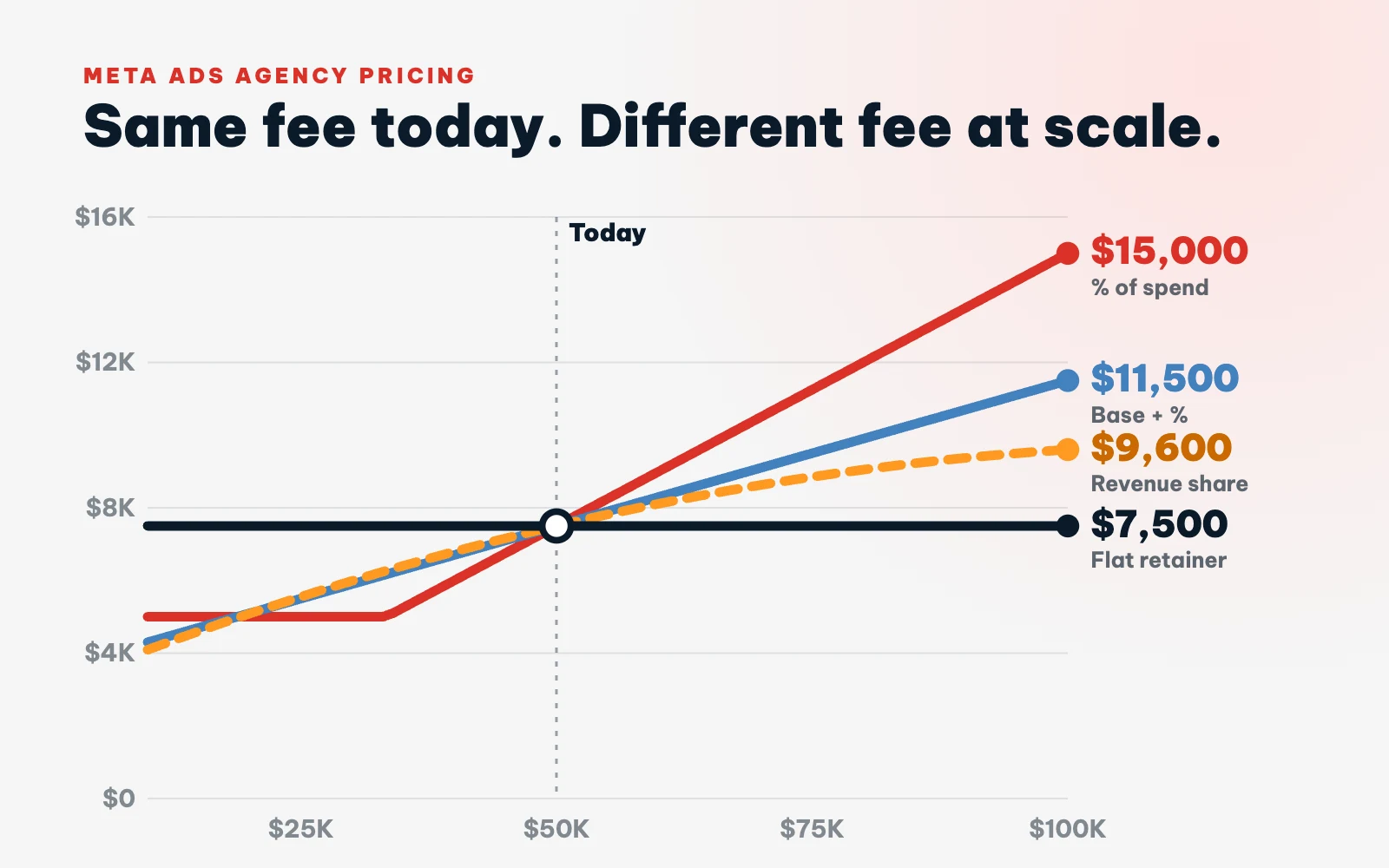
Four proposals can cost the same this month and very different amounts once you scale. Here is what each fee structure pays a Meta agency for, how to stress-test a quote against your margin, and the terms that matter more than the rate.
Same fee today. Different fee at scale.
Monthly agency fee for four example quotes, by monthly Meta spend
Most Meta ads agencies charge a flat monthly retainer, a percentage of ad spend, or a mix of the two. A smaller group ties part of the fee to results.
Among agencies that publish their prices, management fees start at about $750 a month for accounts spending up to $5,000 and reach $25,000 to $30,000 a month at $250,000 in spend. Published percentage rates run from 5% to 25% of spend, and the rate drops as spend grows (Flighted, prices checked October 2026).
AdvertiseMint's published rate card shows how a sliding percentage works: 25% of spend between $10,000 and $24,999 a month, 20% up to $99,999, 15% up to $249,999, 10% up to $999,999 and 5% above that, on month-to-month contracts with no setup fee (AdvertiseMint pricing).
Ad spend is paid to Meta on top of every one of these. Creative production, creator fees, landing pages and tools may sit inside the fee or be billed separately.
Every structure can work. The question is what it rewards the agency for, and whether that matches the thing that limits your growth.
| Structure | How it is charged | What it pays for | When you scale | In a bad month | Watch for |
|---|---|---|---|---|---|
| Flat retainer | A fixed monthly fee for a written scope | The people and work in the scope | The fee stays flat. Expect a review once the work grows. | You pay the full fee on less spend. | Vague scope. "Creative included" can mean two resized images or a full testing pipeline. |
| Percentage of spend | A share of monthly Meta spend, often with a minimum and a rate that falls as spend grows | Spend | The fee rises with spend, whether or not the extra spend is profitable. | The fee falls with spend, down to the minimum. | A reason to recommend more budget, and a fee that does not track the work, which rarely grows in a straight line with spend. |
| Base plus percentage | A smaller fixed fee plus a smaller share of spend | A staffed team, plus volume | Rises with spend, more slowly than a pure percentage. | Falls toward the base. | What the base alone covers if spend drops. |
| Performance fee | A fee per sale or lead, a share of revenue, or a bonus on top of a base | Whatever the contract measures | Rises with measured results, which are not always extra results. | Falls, which is the appeal. | Paying for sales that would have happened anyway, measured by a number the agency can change. |
Agencies quote in different shapes, so the monthly number on page one of a proposal tells you little. Write each quote as a formula, then run it through three months you will actually have: this month, the month you double spend, and a month when you cut back. Then look at what each one leaves you after ad spend and the fee.
The tool starts with four quotes that all cost $7,500 at $50,000 a month in spend. These are example inputs, not market rates. Replace them with your own numbers.
Your contribution after ad spend, before any agency fee
Today$32,500
Spend doubles$21,000
Spend drops 30%$22,750
$7,500 a month
| Measure | Today | Spend doubles | Spend drops 30% |
|---|---|---|---|
| Agency fee | $7,500 | $7,500 | $7,500 |
| Your profit | $25,000 | $13,500 | $15,250 |
When spend doubles, the fee stays the same and your profit falls $11,500.
15% of spend, $5,000 minimum
| Measure | Today | Spend doubles | Spend drops 30% |
|---|---|---|---|
| Agency fee | $7,500 | $15,000 | $5,250 |
| Your profit | $25,000 | $6,000 | $17,500 |
When spend doubles, the fee rises $7,500 and your profit falls $19,000.
$3,500 plus 8% of spend
| Measure | Today | Spend doubles | Spend drops 30% |
|---|---|---|---|
| Agency fee | $7,500 | $11,500 | $6,300 |
| Your profit | $25,000 | $9,500 | $16,450 |
When spend doubles, the fee rises $4,000 and your profit falls $15,500.
$3,000 plus 3% of revenue
| Measure | Today | Spend doubles | Spend drops 30% |
|---|---|---|---|
| Agency fee | $7,500 | $9,600 | $6,150 |
| Your profit | $25,000 | $11,400 | $16,600 |
When spend doubles, the fee rises $2,100 and your profit falls $13,600.
Profit here means revenue times contribution margin, minus ad spend and the agency fee. The revenue share is paid on the revenue you enter. The bad month assumes revenue per $1 stays at today's level. Creative production, creators and tools billed outside the fee are not included.
If the fee rises while your profit falls, the agency is paid more for a move that leaves you with less. In the example, doubling spend doubles the percentage fee and cuts the brand's profit by more than three quarters.
A flat retainer costs you the most when you cut spend. Ask what happens to it if you pull back for a quarter, and whether the scope shrinks with it.
The tool pays the revenue share on the revenue you enter from your store. If the contract pays on revenue Meta reports instead, the fee follows Meta's count, which depends on a setting covered below.
"Only pay for results" sounds like the safest deal on the table. It is only as safe as the definition of a result. Few agencies price this way: in Credo's agency pricing survey (last updated in 2022), 6.56% of social ads providers offered billing on a share of profits or uplift, against 51.8% offering a flat fee.
Easy to read and easy to game. It rewards volume, so define exactly what counts: a first order, a minimum order value, a qualified lead.
Grows with sales. Paid on all revenue, it also pays the agency for repeat customers and for sales your brand would have made without any ads.
The base keeps a senior team on the account. A capped bonus pays for beating a target you agreed in advance. For most brands this is the version worth negotiating.
In Ads Manager, standard attribution credits a sale to your ad if it happens within 1 or 7 days of a click, or within a day of someone seeing the ad. Meta also offers incremental attribution, which counts only the conversions its models predict the ad caused, and it warns that results under different attribution models cannot be compared (Meta Business Help Center).
So the same month can produce different "results" depending on a setting the agency controls. A fee paid on that number pays for the setting as much as for the work.
The cleanest check is a holdout. Meta's lift studies show your ads to a random test group, hold back a control group, and measure the difference (Meta lift studies). Meta says access to Conversion Lift is limited, so ask your Meta representative, or agree a regional holdout with the agency. More on reading Meta's numbers in how to measure Meta ad performance.
Start from what limits growth today, then choose the structure that pays for fixing it.
| If this is true | Lean toward | Be careful with |
|---|---|---|
| New ads are what limit growth | A retainer scoped in creative output: new concepts tested each month, in named formats, by named people | A percentage of spend, which pays for budget rather than new ads |
| You plan to scale spend quickly | A retainer with an agreed review point, or a percentage with lower rates at higher spend and a cap | An uncapped percentage priced only at today's spend |
| Spend swings with seasons or launches | A percentage with a minimum, or a base plus percentage | A flat fee sized for your busiest months |
| Tracking is solid and the agency runs the creative, offer and landing page | A base fee plus a capped bonus on new-customer revenue or contribution margin from your store | A pure revenue share on Ads Manager numbers |
| You do not trust your numbers | A retainer while you fix measurement | Any performance fee |
Hours and "unlimited revisions" tell you little. Ask how many new concepts will be tested each month, in which formats, who makes them, and how results reach the people making the next round. Our creative velocity calculator estimates how many your spend needs.
A percentage of spend pays the agency more when budget goes up, even if the new ads that would make the extra budget profitable never arrive.

Two proposals at the same rate can cost very different amounts once you add the terms around it. Get each of these in writing.
Terms vary widely. In Credo's survey, 30.49% of social ads providers required a 6 to 12 month contract, while AdvertiseMint publishes month-to-month contracts. Already locked into an agency that is not working? Read should you fire your Meta ads agency.
For the questions that expose a weak proposal, see questions to ask a marketing agency. If you are comparing agencies across more channels than Meta, see our ecommerce marketing agency pricing guide.
There is no single cutoff, and most published numbers come from agencies with a stake in the answer. Guides put the point where an agency makes sense at $15,000 to $25,000 a month, $20,000 a month or past $30,000 a month in ad spend.
Weighing one specialist against a team? See Meta ads agency vs. freelancer. Thinking about hiring instead? See agency vs. in-house team.
First Spark's Meta ads management starts from $5,000 a month. Above that, we scope each engagement around the account, the creative it needs, the brand's growth stage and how much of the strategy we own. The details are on our Meta ads management pricing page, and our Meta ads management page explains how we run accounts. See what that has produced on our client results page.
We do our best work with brands spending around $30,000 a month or more on ads, where the media and the creative need to work as one system and the numbers that matter are new customers and contribution margin. We are not the right fit if you want the lowest monthly fee, or only need someone to launch ads your team has already made.
Among agencies that publish prices, Meta management fees run from about $750 a month for accounts spending up to $5,000 to $25,000 to $30,000 a month at $250,000 in spend, according to Flighted's October 2026 check of published rates. Ad spend is paid to Meta on top, and creative production may be extra. Compare quotes at the spend you plan to reach, not only at today's.
Published rates run from 5% to 25% of spend, and the rate usually drops as spend grows. AdvertiseMint, for example, publishes 25% of spend between $10,000 and $24,999 a month, falling to 10% between $250,000 and $999,999. Many percentage quotes also carry a minimum monthly fee.
Neither is better on its own. A retainer is predictable and does not reward extra spend, but you pay all of it in a slow month and it needs a clearly written scope. A percentage moves with your budget, but it grows whenever spend grows, whether or not the extra spend is profitable. Price both at today's spend, at double spend and in a bad month, and pick the one that leaves you more contribution margin at the spend you plan to reach.
They can, when the result is measured on numbers from your own store, the fee is paid on new customers or revenue above an agreed baseline, the variable part is capped, and the agency controls what drives the result. Paid on revenue that Meta reports, a performance fee can pay for sales that would have happened anyway.
Numbers you control: new-customer revenue or contribution margin from your store or finance system, against a baseline agreed before the agency starts. If Ads Manager numbers are used, write the attribution setting into the contract, because Meta credits sales differently under its standard and incremental attribution models.
Usually not. You pay Meta directly for ad spend, ideally from an ad account in your own Business Manager. The agency fee covers management and the agreed scope. Creative production, creators, landing pages and tools may be included or billed separately, so ask for a written list.
The minimum fee and term, the notice period, any setup fee, what the fee includes and excludes, when the fee is reviewed, and who owns the ad account, pixel, data and creative. Terms vary widely: some agencies publish month-to-month contracts, while Credo's agency pricing survey found 30.49% of social ads providers required 6 to 12 months.
There is no single cutoff. Published guides put the point where an agency makes sense between about $15,000 and just over $30,000 a month in ad spend. Below about $10,000 a month, a retainer takes too much of the budget, and a freelancer or your own team usually fits better. First Spark does its best work with brands spending around $30,000 a month or more on ads.
First Spark's Meta ads management starts from $5,000 a month. Above that, we scope each engagement around the account, the creative it needs, the brand's growth stage and how much of the strategy we own. Our Meta ads management pricing page has the details.
Tell us your spend, your margins and where growth is stuck. We will map the scope your account needs rather than sell you a preset package. We work with D2C, CPG and SaaS brands, and we do our best work with brands spending around $30,000 a month or more on ads.
Talk to our team